AI agent costs are a control problem
The cheapest Claude Code workflow is not about the tool. It is about who is driving.

The billing lane changed
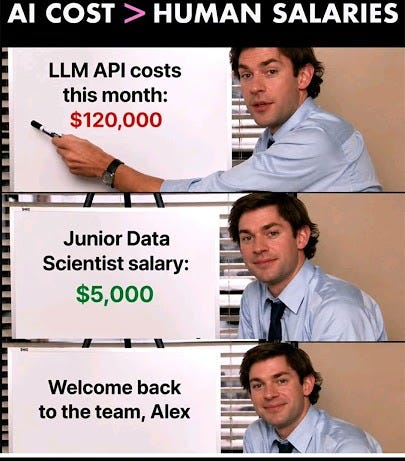
AI agent costs are getting messy because the same workflow can now fall into two different billing lanes.
On June 15, Anthropic moves Agent SDK and automated Claude usage into a separate credit pool.
That matters because a workflow that feels like “just Claude Code” may no longer be billed like normal Claude Code.
If you are typing in a terminal, you are still basically driving the car yourself. That stays connected to your normal Pro, Max, or Max 20x subscription.
If another system fires the agent in the background, that starts looking like automated usage.
That is the toll road.
The practical question is not “which agent tool is best?”
The better question is: who is driving?
The cheap road is human-driven

This is why tools like Zed Terminal Threads, cmux, tmux, and WezTerm..etc are suddenly more interesting.
They keep the workflow close to the terminal. They keep you in the loop.
They make the agent feel less like a hidden automation layer and more like a person directing work in real time.
That is not just a UX detail anymore.
It may be the difference between normal subscription usage and metered automated usage.
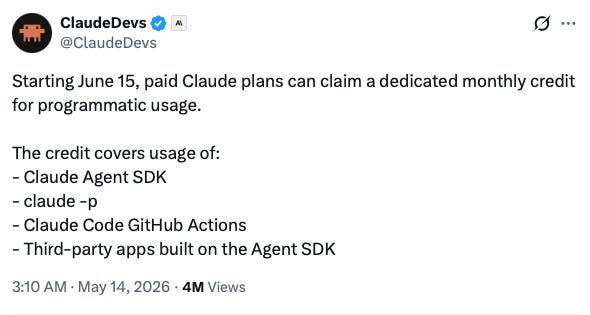
The June 15 credit pools are small compared with what serious agent workflows can burn:
$20 for Pro
$100 for Max 5x
$200 for Max 20x
No rollover
Full API-style pricing once automated usage escapes the subscription lane
So if you run a lot of agents, the bill can move fast.
The tool is not the moat

The trap is thinking this is solved by picking the right terminal wrapper.
It is not.
A wrapper can keep you in the cheaper lane today. It can help you avoid unnecessary background automation.
It can make Claude Code more usable without burning API-style credits.
But Anthropic controls the definition of “interactive.”
That line has already moved more than once this year.
So use the cheap road while it exists. Just do not build your whole operating system around a pricing definition you do not control.
That is the difference between optimization and dependency
Watch the invoice, not the changelog

The changelog tells you what shipped.
The invoice tells you what changed in reality.
If you are running agents for real work, especially business workflows, you need to watch where cost actually appears.
That means tracking three things:
Which tools launch Claude directly from you
Which tools run Claude in the background
Which tasks could move to local models without hurting output quality
Most people only compare model intelligence.
That is the wrong layer.
The expensive layer is orchestration. It is how often the model gets called, who starts the run, how much context is passed, and whether the workflow sits inside someone else’s meter.
The road nobody can meter
The only road nobody can meter from the outside is the one you own.
That does not mean every business should run everything local.
Local models still have trade-offs. They need hardware, setup, maintenance, and judgment.
They are not magic.
But they give you a control layer that cloud subscriptions cannot give you.
The smart setup is not cloud versus local.
It is a routing system:
Claude for high-leverage thinking and coding moments
Terminal workflows for cheap human-driven agent work
Local models for repeatable tasks where control matters more than peak intelligence
That is the actual cost strategy.
Not chasing every pricing update.
Not pretending local AI solves everything.
Just knowing which road you are on before the toll booth shows up.
Watch the video here:
Author’s note: An LLM was used for this post (transcribed the video and summarized here, all I did was put images in between and hit “publish” button)